Anveshanā

Browsing January 2026 Issue.

Vol 2 • Issue 1 – January 2026
Read Full Issue (PDF)
Asad Ali Khan (1937–2011), born in Alwar and shaped by the Jaipur lineage, stands among the most luminous voices of Hindustani classical music. Revered as Khansaab, he represented the epitome of sādhanā and discipline in Rudra Veena. Across the world, his playing carried a rare integrity, leaving behind a legacy that still feels austere and unmistakably alive.

The interview presented in these pages was conducted on 24 January 2010 at Khansaab’s home in New Delhi by Ananya Chaturvedi, Taruna Kumari, and Raghav. Sixteen years later, Anveshanā is honoured to offer this conversation to its readers, as a gesture of respect to an enduring legacy and to the quiet purity with which Khansaab lived and made music. The interview was originally in Hindi but an English translation is presented alongside for a wider audience. (Read Now)
At Khansaab’s Doorway: A couple of Memories

by Jyoti Hegde and C.S. Aravinda (▾)

Jyoti Hegde: Khansaab was extremely strict, disciplined, and a man of strong principles. He was a true king in his field and lived with that dignity throughout his life. I believe his strictness with me shaped me into a stronger person-strong enough to pursue the Rudra Veena. He would get furious over even small mistakes and never tolerated them, which made me constantly aware of the need for precision and perfection. I believe his way of showing love was through scolding. He did not teach me every time I visited-sometimes I received nothing, sometimes...

C.S. Aravinda: Certain events in life unexpectedly leave indelible imprints. So it was, almost 20 years back, in the month of February of the year 2006, that I was immensely fortunate to experience a feast of musical extravaganza – the three-day Dhrupad Music Festival – featuring two performances each day, organized by the Prakriti Foundation at the Egmore Museum Theatre in... (Read Now)
Amit Kuber is a mathematician and an Associate Professor of Mathematics at the Indian Institute of Technology Kanpur (IITK) since 2016. His research spans combinatorial and order-theoretic methods in representation theory, as well as model-theoretic aspects of K-theory. Having pursued education at the University of Pune, the University of Cambridge, and the University of Manchester, he is also a committed advocate of honest teaching and has been recognised at IIT Kanpur with the Distinguished Teacher Award and the Excellence-in-Teaching Award.

In this conversation with Purnima Tiwari and Aayush Verma for Anveshanā, Prof. Kuber reflects on his childhood and early influences, on discipline as a way of safeguarding curiosity, his mathematics, and on the academic journey that carried him from Pune to Europe and back to India. (Read Now)
A Journey to the Valley of God

by Debojit Chanda (▾)

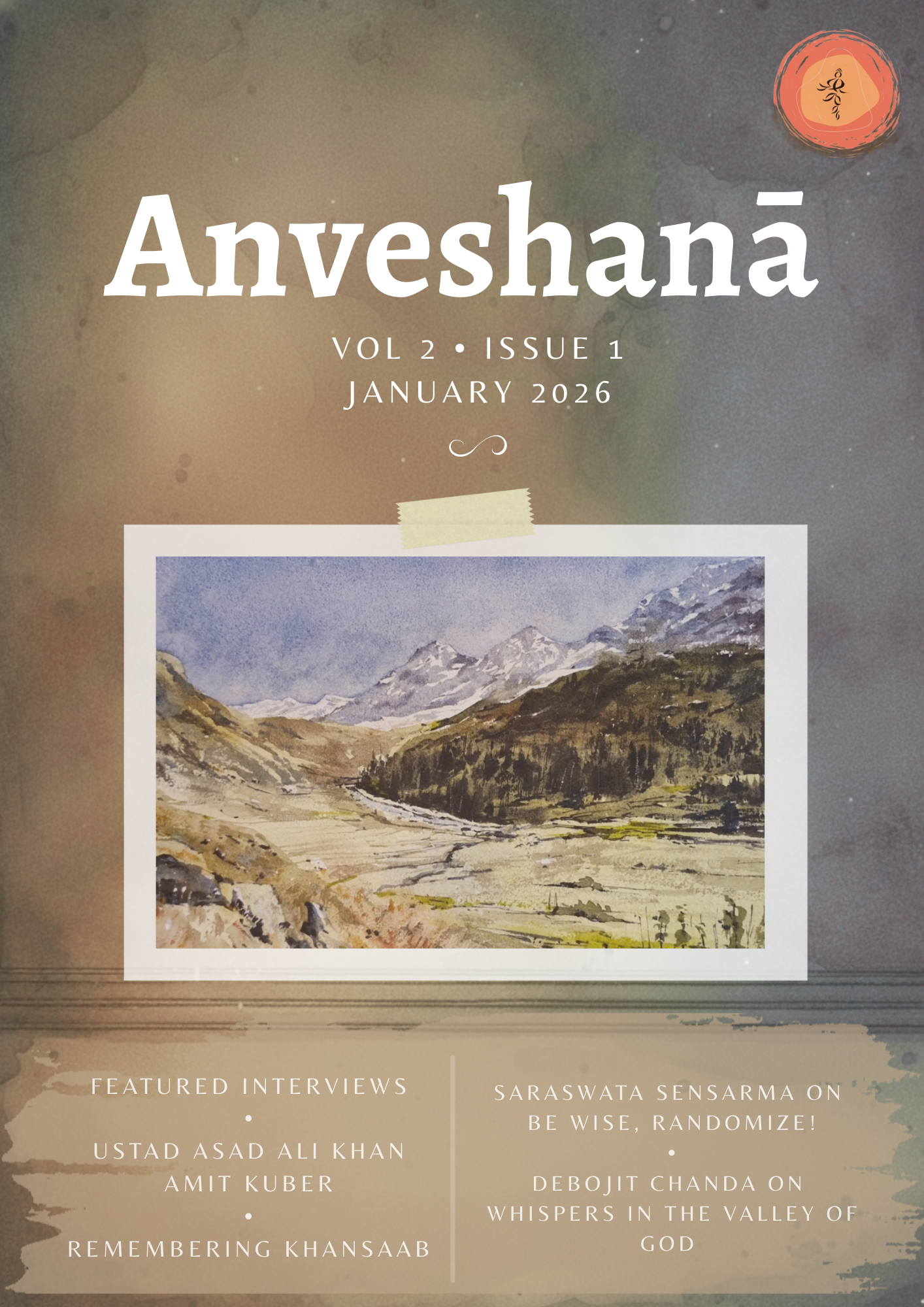
The way of life is an enigma, like navigating through an ever-changing maze that too on a pitch-dark night. In this strange journey, a hobby becomes a small lamp, revealing only a few steps ahead, just so we can push towards an uncertain end. Like many fellow travellers, I also hold two such lamps: painting watercolours and gazing at mountains. Though they seem worlds... (Read Now)
Be Wise, Randomize!

by Saraswata Sensarma (▾)

``God does not play dice with the universe.''
The above quote expresses the discomfort and disdain of Albert Einstein with the stochastic description of the microscopic world in quantum mechanics. He had his reservations about departing completely from a deterministic worldview and deemed quantum mechanics to be an intermediate step towards a unified field theory ... (Read Now)
Anveshanā Issue 1 Cover

Subscribe for Issue Notifications

Contribute to Anveshanā

Anveshanā is a bi-annual (twice a year) e-magazine. We are open for submissions, please send your articles to the editorial team. Please go through the instructions to the authors for some guidelines

© Anveshanā 2026