Anveshanā

Celebrating the spirit of truth, beauty, and inquiry.

Vol 2 • Issue 2 – July 2026
Read Full Issue (PDF)
Know, we must. Know, we will.

by the Editorial Board (▾)

Is it truly the case that the scientific pursuit born of sheer curiosity lacks value? The question is older than science itself. “Curiosity, which may or may not eventuate in something useful, is probably the outstanding characteristic of modern thinking,” said Abraham Flexner in The Usefulness of Useless Knowledge. Before asking whether any knowledge is useful, one must ask what it means for knowledge to possess a use. Is the usefulness just the correspondence... (Read Now)
Rukmini Dey is a mathematician and mathematical physicist at ICTS-TIFR, Bengaluru. Her research lies at the interface of geometry and mathematical physics, with a focus on quantization and optimization problems. She completed her PhD at Stony Brook University in 1998 under the supervision of Leon Takhtajan. Before joining ICTS-TIFR, she was a faculty member at HRI, Prayagraj. She is also a passionate poet and writer.

In this conversation with Purnima Tiwari and Aayush Verma for Anveshanā, Prof. Dey reflects on her childhood, her mentors, mathematics as poetry, her years at IIT Kanpur, the problem of quantization, the importance of outreach, and an academic journey shaped by geometry. We are also delighted to include a selection of her poems with this interview. (Read Now)
Partha Sarathi Chakraborty is a mathematician at the Indian Statistical Institute (ISI), Kolkata. His research interests lie in operator algebras and noncommutative geometry. After completing his PhD under the supervision of Kalyan Bidhan Sinha at ISI Delhi, he held research positions at IHÉS and the Institute of Mathematical Sciences (IMSc), Chennai. In 2018, he joined ISI Kolkata as a Professor of Mathematics.

In this conversation with Saraswata Sensarma, Purnima Tiwari, and Aayush Verma for Anveshanā, Prof. Chakraborty reflects on his upbringing in Bengal, his early fascination with science, the meaning of doing mathematics, his approach to research and teaching, the influence of K. R. Parthasarathy's mentorship, and his journey through the different campuses of ISI—both as a mathematician and as an individual. (Read Now)
K. K. Suresh Kumar is the Librarian at Harish-Chandra Research Institute (HRI), Prayagraj. Born into the Kodava community of Karnataka, he discovered a love for books at an early age, a passion that led him to pursue Library and Information Science at Kuvempu University, Karnataka. Before joining HRI in December 2017, he served at the Indian Institute of Management Bangalore (IIM-B), ESSAE–TAPMI Academy, Bangalore, and the Amrita Vishwa Vidyapeetham University Bangalore campus, where he contributed to the development of modern academic library services.

In this interview with Anveshanā, Dr. Suresh Kumar reflects on his childhood in Chikkamagalore District, the mentors and family who shaped his journey, his philosophy of service, the evolving role of libraries in the digital age, and his enduring commitment to open access and making knowledge accessible to all. (Read Now)
How mathematicians changed the world of finance, Forever.

by Sruthi Subramanian (▾)

Mathematics and Finance have traditionally been perceived as disjoint fields. At least in India, many students choose commerce because they do not enjoy mathematics, while those who do are often steered towards science by default. Commerce and finance are taught in a way that is largely disconnected from mathematics, at least at the school level. Formulas are used, but they are not proved, and the underlying mathematical ideas are rarely emphasized. At the same time, so-called pure mathematicians... (Read Now)
Untie the Knot!

by Prognadipto Majumder (▾)

We instinctively know what a knot is. This article will be a tale of how knots are viewed through the lens of topology, and how a generation of mathematicians has worked to study them from a purely algebraic standpoint. For our purposes, we can agree upon a knot to be a string, possibly twisted or knotted, with no loose ends. A link is defined to be some number of knots arranged in some specific way... (Read Now)
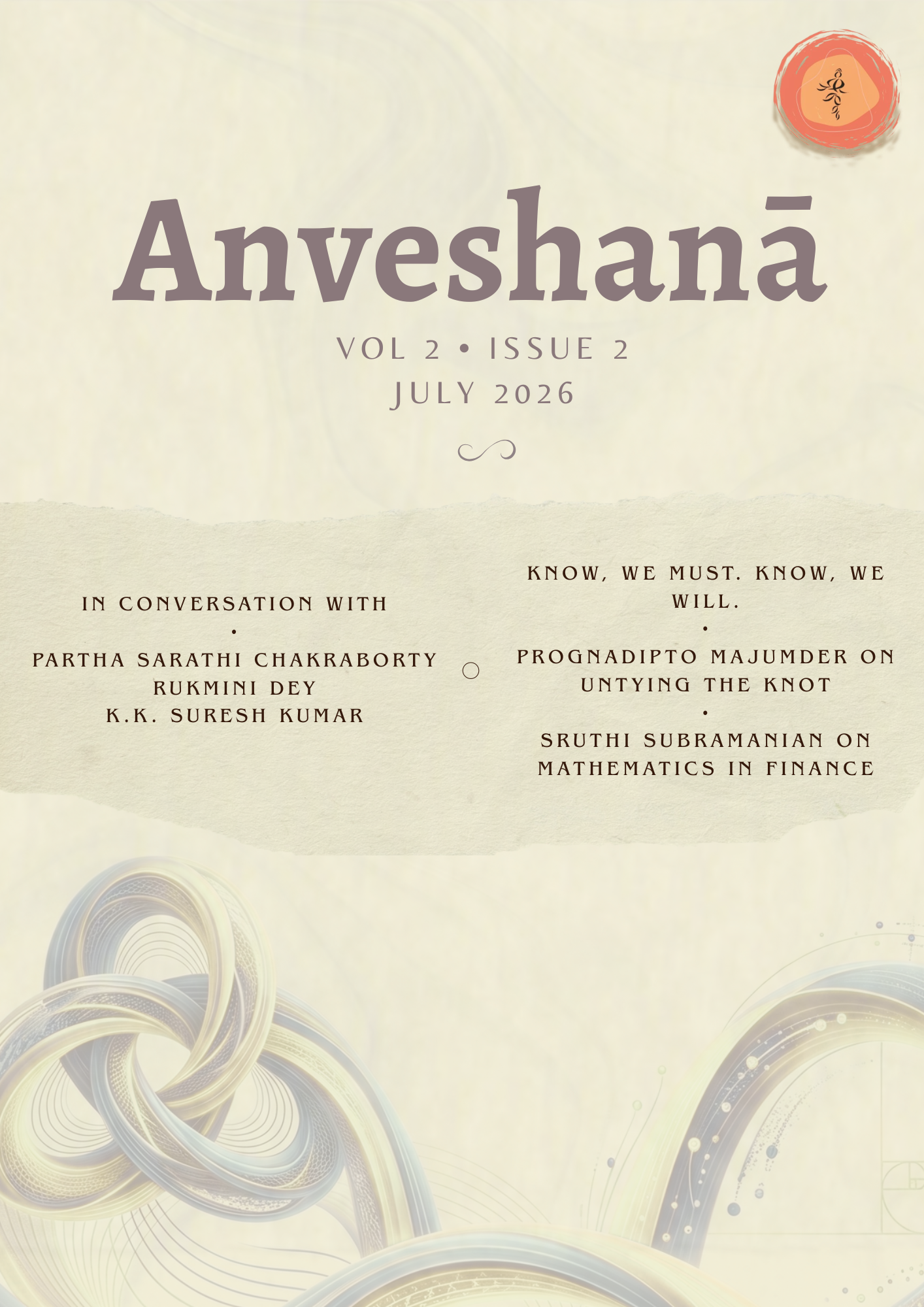
Anveshanā July 2026 Cover

Subscribe for Issue Notifications

Contribute to Anveshanā

Anveshanā is a bi-annual (twice a year) e-magazine. We are open for submissions, please send your articles to the editorial team. Please go through the instructions to the authors for some guidelines

© Anveshanā 2026